A guidebook and planning tools for family ski trips from Tokyo.The family ski guidebook — from TokyoStart planning
Last Updated: September 13, 2026
Late-Season Japan Ski with Kids: Mid-March, April, and Golden Week — A Family Guide
A father-of-two's honest guide to skiing Japan in mid-March, April, and Golden Week — based on real Naeba and Kagura family trips. Three windows, what spring snow feels like, ski-school options for kids, and Plan B essentials.
Most international families think Japan ski season runs from December through March. That is true for most resorts. But if your school holidays are in March or April, or if you are thinking about a trip during Golden Week (Japan's late-April-to-early-May holiday week), you still have choices. There are fewer choices than in mid-winter, and each one has trade-offs. I want to share these honestly before you book your trip.
This guide is based on two of my own trips this season. The first was a three-night family stay at Naeba in mid-March, with my 8-year-old son and 5-year-old daughter. My wife was traveling for work, so I was alone with the kids. The second was a one-day visit to Kagura in mid-April with my son. The two trips were six weeks apart, but the snow and the experience were so different that they felt like different mountains.
Late-season skiing in Japan is real. For some families, it is the best option you have. But it is not just "winter skiing in warmer weather." It is a different kind of trip. The planning rules are different. Here is what I have learned.
Why most Japanese resorts close by early April
In winter, cold winds from Russia pick up moisture as they cross the Sea of Japan. They then drop heavy snow on the western mountains of Japan. This is why Japan has so much snow in winter.
By late March, the weather changes. Fresh snow becomes rare. Most lower-mountain resorts run out of snow. Lifts and grooming cost money to run, but fewer people visit late in the season. So many resorts close.
A small number of resorts are higher up the mountain. They keep enough snow on the ground to stay open into April or even early May. Most of these resorts are in Niigata and Nagano.
The three windows of late-season skiing
Late-season is not one single thing. In the six weeks between mid-March and Golden Week, the snow and the resort options change a lot. I think of late-season as three different windows.
Window 1: Mid-to-late March
This is the busiest late-season window in Japan. It overlaps with Japanese spring school holidays and a three-day weekend. There are many people on the slopes. Most resorts are still running all their lifts. The snow can be very different from one resort to another, depending on how high the mountain is and how much snow fell that winter.
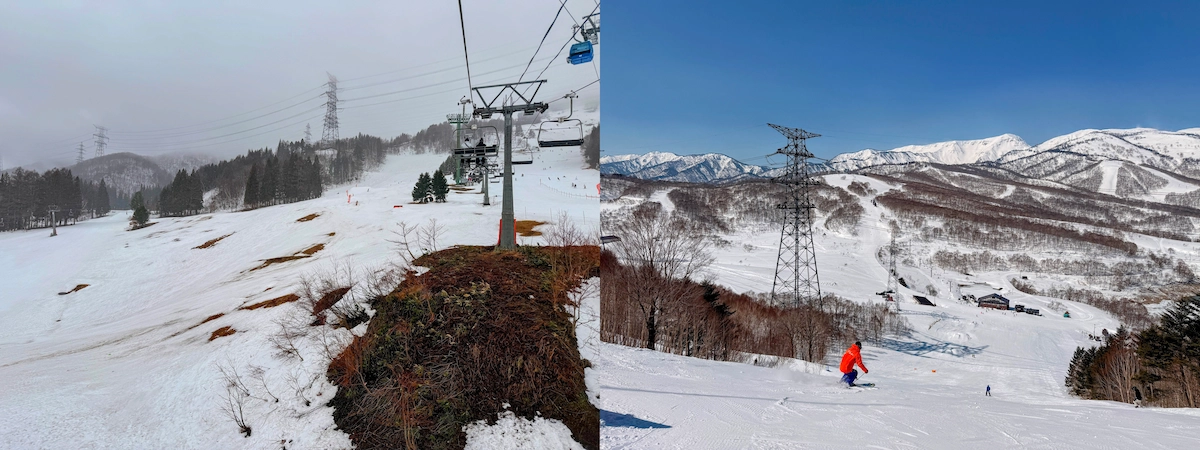
This season was a low-snow year. When I visited Naeba on March 18, many parts of the slope had no snow at all. You could see the ground. The resort was open, but only some lanes were skiable. The narrow slopes felt crowded, even on a Wednesday. Six weeks earlier, the same place was fine. By mid-March, it was already past its best time.
But higher up the mountain, the picture was completely different. On Day 3 of the same trip, we drove from Naeba to the Tashiro area of Kagura. The snow there was almost 3 metres deep. The slopes were fully covered. There were not many people. Same week, same area, totally different mountain.
The lesson: in mid-March of a low-snow year, mountain height matters more than the season. If you are booking now and have flexibility, choose a higher-elevation resort.
Window 2: Early April
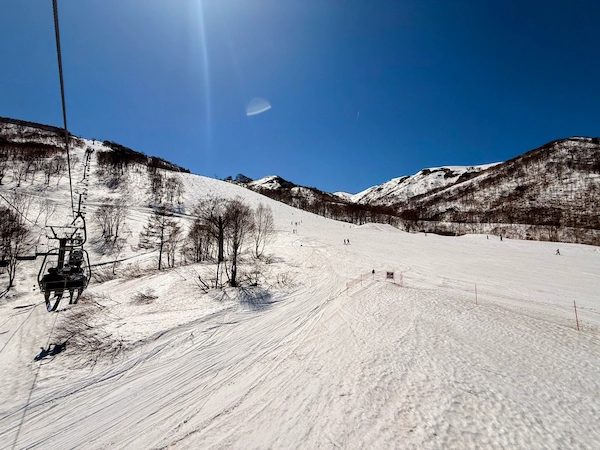
By early April, most lower-mountain resorts have closed. The ones that stay open run with fewer lifts. Crowds drop a lot when Japanese school holidays end. Some international visitors are still there, but in smaller numbers.
This window is genuinely quiet. The snow on the upper mountain is often still good. If you can travel during this window, you get the best balance of "resort still open" and "no crowds" of the entire late season.
Window 3: Late April through Golden Week
Only a few resorts are still open. Crowds spike again during Golden Week (late April through early May). This is especially true for international families on school breaks. The snow on the upper mountain is still skiable. The lower runs are patchy or closed.
This window is for families who absolutely cannot travel earlier. There is real skiing to be had, as long as you set your expectations correctly.
Resorts I recommend, by window
For mid-to-late March (Window 1)
- ✓Kagura — The best snow in the Yuzawa area. The Tashiro side has gentle slopes that suit families with mixed skill levels.
- ✓Naeba — The hotel and the slopes are connected (you can walk from your room to the lifts). This is very useful for families. But in low-snow years, the lower mountain becomes patchy. The higher slopes are better.
- ✓Hakuba Valley — All ten resorts are still open in mid-March. You have many options.
- ✓Karuizawa — Reliable for early-stage learners. The beginner slopes use machine-made snow, so they stay in good condition.
For early April (Window 2)
- ✓Kagura — The upper mountain still has excellent snow.
- ✓Hakuba Valley — All major resorts are still open.
- ✓Goryu, Tsugaike, Happo-One — All open on top part of the mountain.
For late April and Golden Week (Window 3)
Closing dates for the 2025–26 season:
- ✓Kagura — open into early May (the date changes year to year)
- ✓Goryu — open through May 6, 2026
- ✓Tsugaike — open through May 6, 2026
- ✓Happo-One — closes April 19, 2026
- ✓Hakuba Norikura — closed March 29, 2026
If your trip is before April 20, you can choose any resort in the Hakuba Valley. From late April through Golden Week, your main options are Goryu, Tsugaike, and Kagura. All three have higher upper mountains, so they keep snow into May.
What spring snow actually feels like
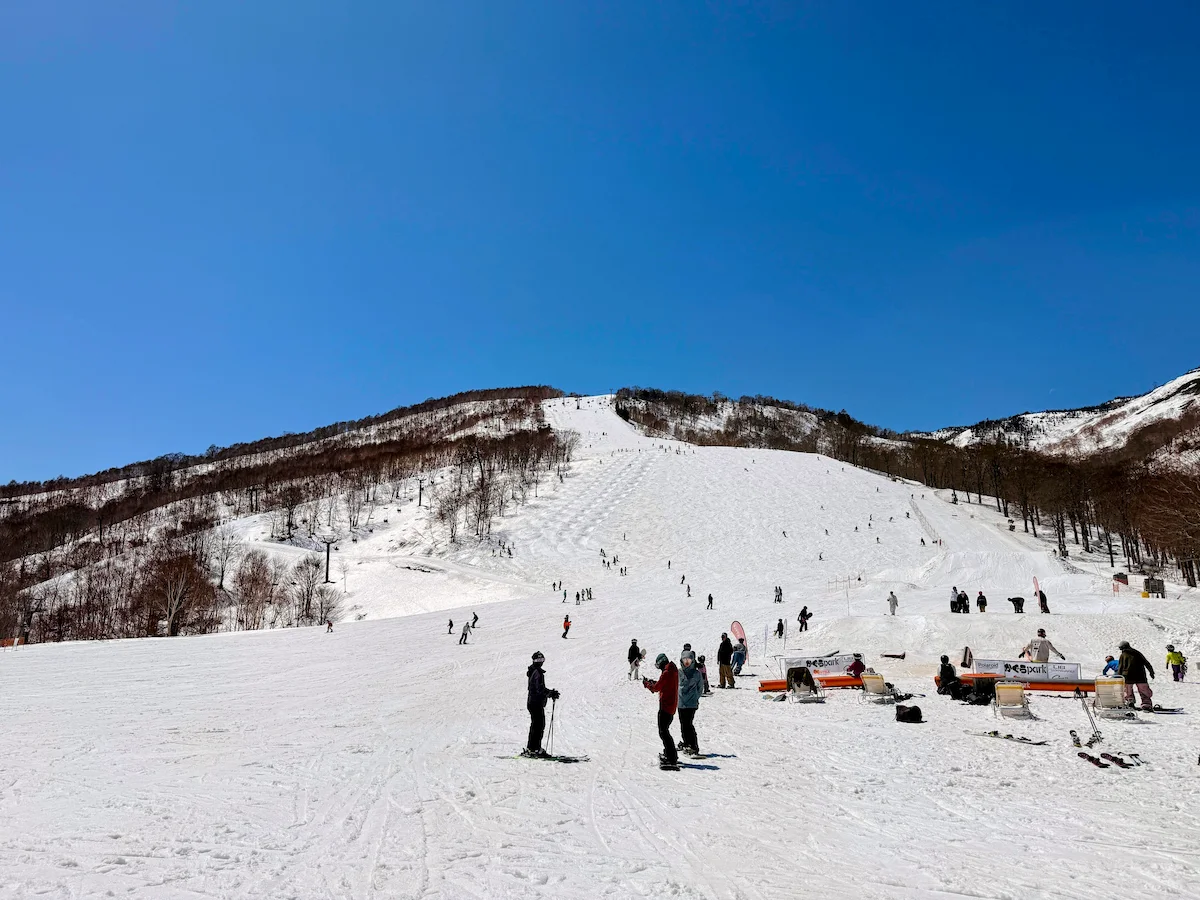
If you have only skied in mid-winter, spring snow will surprise you. There are three main differences.
The snow is softer and slower. In Japanese, spring snow is called zarame. In English, it is often called "corn snow," because the snow becomes small wet balls, like grains of corn. Corn snow is forgiving, but it is sticky.
This causes a problem for beginner snowboarders. On flat parts of the slope, the snowboard does not move well on corn snow. My son normally has no problem with green (easy) runs. But in April at Kagura, on a flat part of the Gondola Course, his snowboard kept stopping. He had to take it off and walk. So if you have young or new riders in your family, prepare for this. The afternoon is the worst time, because the snow is warmest then.
Mogul runs become better, not worse. A mogul is a small bump on the slope. Moguls form when many skiers turn on the same spot, again and again. In mid-winter, fresh snow fills in the bumps and makes them shallow. In spring, there is no fresh snow, so the bumps grow taller and deeper. The shape stays steady. This is actually good for practice.
In April at Kagura, the Mogul Bahn (the main mogul run on the slope) was busy with serious skiers all day. Even some snowboarders were trying the bumps. If anyone in your family wants to learn moguls, spring is a good time.
Terrain parks open up. A terrain park is an area on the slope with jumps and rails for tricks. Some resorts only set up their park when the snow is soft. Soft snow makes landings safer. Kagura Park on the main slope had two jumps (one small, one large), several rails, and a few other features. The small jump was easy enough that my 8-year-old son could try it. If your kids want to try jumping, late-season parks are friendlier than mid-winter parks.
One more point about low-snow years. When the winter has not had much snow, the slopes get narrower. At Naeba in mid-March this season, runs that are normally 50 metres wide were only 20 metres wide. The rest was bare ground. Beginners, snowboarders sitting down to rest, and faster skiers all had to share the same narrow lane. Even on a normal day, the slopes felt crowded.
Honest warnings I wish I had known
These are the things I would tell another family who is planning a late-season trip.
Wind closures at Kagura happen all year
Kagura's upper lifts often close because of strong wind. This is true in winter, spring, and early season — not just in spring. On both my visits this year (March and April), the Tashiro side of Kagura was closed at some point in the day because of wind. In April it stayed closed all day. In March, it reopened around 10 AM. I only knew because I was checking the resort's Facebook page that morning.
Always check the resort's official website or Facebook page on the morning of your visit. The lift status can change every hour. Always plan a Plan B before you leave home. Your Plan B can be another resort, a non-ski activity in Yuzawa town, or an indoor play area at your hotel. For families with kids, a Plan B is important. If conditions are bad and you have no backup, the kids will become unhappy. The whole trip can become difficult.
If you drive from Tokyo to Naeba, do not take the Mikuni Pass route
This warning is for Naeba specifically. Google Maps will show you two driving routes from Tokyo. One route uses the Kan-Etsu Expressway (Japan's main highway from Tokyo) all the way to the Yuzawa exit, then you go back a short way on local roads. The other route leaves the highway earlier at the Tsukiyono exit, then goes over Mikuni Pass on Route 17.
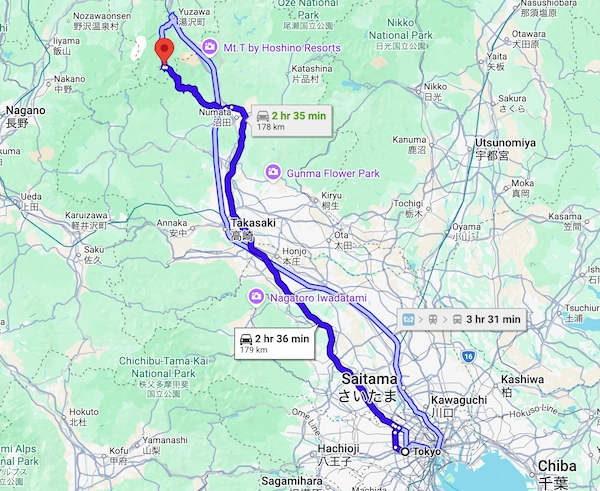
The Mikuni Pass route looks shorter and cheaper on Google Maps. Do not take it with kids. The mountain road has many tight curves, one after another. My 8-year-old son got carsick about two-thirds of the way up. The rest of the drive was hard for everyone.
Take the Yuzawa exit, even if it costs a little more. The road from there to Naeba is much gentler.
Plan for a slow start to your day
We arrived at the Mitsumata parking lot at Kagura at 9:00 AM in April. The lot was already almost full. We parked at the far end and walked 10 minutes back to the ropeway (a large cable car that holds about 30 people). After we took the ropeway and the gondola (a smaller closed cable car for 6 to 8 people) and one more lift, we finally reached the main Kagura ski area at 11:00 AM. That was two hours from arriving in the parking lot.
For families with young children, this is important. Some advice:
- ✓Eat a real breakfast before you leave home. Do not plan to eat at the resort.
- ✓Bring snacks and water for the long ride up the mountain.
- ✓Tell the kids that today will be a long getting-there day, so they are ready.
Do not bring brand-new skis or boards
In April, some parts of the slope have very little snow. You can see rocks and dirt. I saw skiers hit small rocks on the lower trails. In a low-snow year, this can also happen at higher elevations. If you have just bought new skis or a new snowboard, leave them for next December. Bring older equipment that you do not mind scratching.
The sun is stronger than you expect
On a clear spring day at Kagura, I was hot in a regular winter jacket. Sunscreen is a must. The high mountain, the bright snow, and the long days mean a strong risk of sunburn. I recommend a thin jacket with a hood, instead of a thick winter jacket, for the warmest hours of the day.
Plan a Plan B for bad weather days
Day 1 of our Naeba trip in March started with rain and thick fog. We tried skiing for half a morning, then gave up. We spent the rest of the day at the indoor play area inside the hotel. The kids were happy. I was relieved.
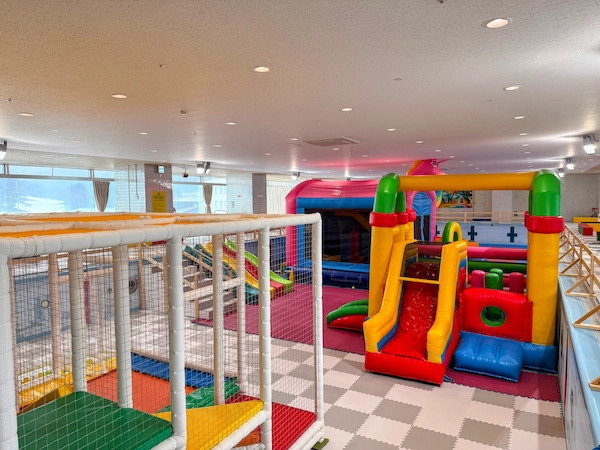
If you book a multi-day trip, choose a hotel that has indoor activities. Examples: an indoor play area, a hotel pool, or a comfortable lobby with games. One bad-weather day during a five-day trip is normal. With a Plan B, the kids stay happy. Without one, one bad day can ruin the rest of the trip.
Lift line manners are different in late season
A small thing that surprised me: at Kagura's main gondola in April, people did not line up in a single straight line. They spread out in a fan shape and joined the line from the sides. With young children, this can be confusing. Stay close to your child and guide them physically into the lift, so you do not get separated.
Late-season skiing with kids when one parent is alone
I did the Naeba trip alone with both kids because my wife was traveling for work. This is a situation that I think more families should plan for. Sometimes one parent flies or drives to the mountain with the kids, while the other parent stays in Tokyo, Singapore, or Hong Kong for work. It is harder than a two-parent trip, but it is doable. The choice of resort matters more than usual.
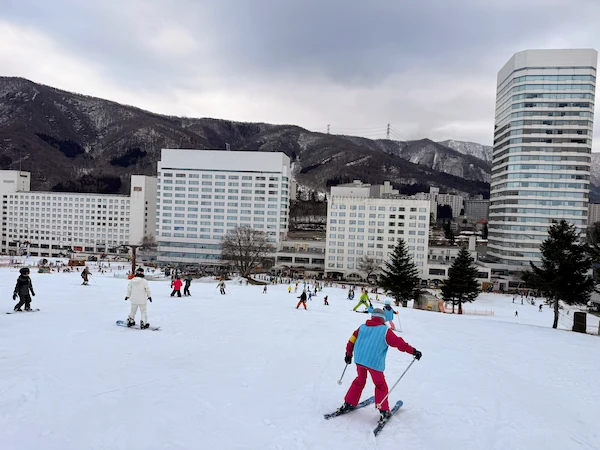
Stay at a hotel that connects to the slopes. This is sometimes called "ski-in/ski-out." It was the most important decision I made for this trip. At 苗場プリンスホテル (Naeba Prince Hotel), you can walk from the hotel directly to the lifts. We put on our ski clothes in the hotel room, walked through a hallway, and reached the snow in five minutes. With one adult and two children of different ages and skill levels, removing the long "get to the slopes" process was the difference between a manageable morning and a chaotic one.
Understand what resort ski schools can and cannot do for kids who are not pure beginners. My 5-year-old daughter has been skiing since she was three years old. She can ride lifts. She can ski green (easy) runs. At Naeba, I tried the resort's young-kids ski school, called PANDARUMAN. PANDARUMAN is excellent for true beginners. It uses indoor practice and a "magic carpet" (a slow-moving belt on the snow, like a flat escalator) to introduce children to snow for the first time. But the program does not include riding chairlifts. Other group lessons at Naeba also keep kids on the magic carpet area, no matter their skill level. For my daughter, this would have meant a full day on a flat practice slope.
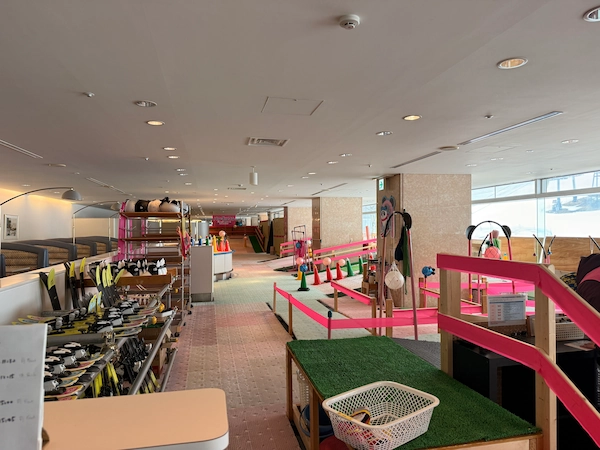
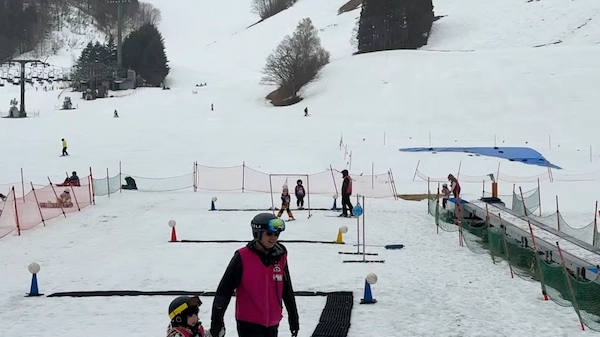
We tried PANDARUMAN for a half day on Day 1. After two hours, my daughter was bored. On Day 2, I changed her to a Naeba Snow School private lesson. The private instructor took her up the chairlifts and on slopes that matched her real skill level. It worked. But private lessons cost much more than group lessons.
If your child is at the in-between stage — not a true beginner, but not yet ready to ski alone on lifts — be ready to pay for private lessons.
For comparison, the Evergreen International Ski School in Hakuba runs English-language group lessons for kids that include lift-served slopes. The price is much lower than a private lesson. If your child is at this in-between skill level, and English-language lessons are okay for your family, Hakuba is worth thinking about just for the school options. I am writing a more detailed comparison of kids' ski schools across Yuzawa and Hakuba — link coming soon.
Choose hotels with non-ski activities for downtime. With two kids and one adult, the rhythm of the day matters. The indoor play area inside the hotel at Naeba Prince Hotel gave me a place to rest while the kids burned energy. A hotel pool, a games room, or a kids' corner all serve the same purpose. The hardest moment of any solo-parent ski trip is when one kid is tired and the other still wants to play. With a play area, you can manage both.
Plan for shorter ski days. Three hours on snow with two kids is more tiring than six hours alone. Plan for this. Start early, take a real lunch break, and finish in the early afternoon. Do not try to maximize hours on the slopes.
Two example late-season trips
Day-trip: Kagura from Tokyo (April version)
For families who want a single-day late-season ski trip from Tokyo, this is the schedule that worked for us in April:
- ✓6:30 AM — Leave Tokyo by car (Kan-Etsu Expressway, Yuzawa exit)
- ✓9:00 AM — Arrive at the Mitsumata parking lot. Change in the car.
- ✓9:30 AM — Reach the ropeway at the base of the mountain.
- ✓10:30 to 11:00 AM — First runs in the main Kagura ski area.
- ✓12:30 PM — Lunch at Restaurant Kagura, at the top of the gondola. Order by 12:30 if possible. We arrived at 1:00 PM and could not find seats easily.
- ✓2:00 PM — Last runs of the day. Begin the trip back down.
- ✓3:00 PM — Leave the parking lot.
- ✓6:30 PM — Back in Tokyo.
If you use the train, add about 30 minutes at each end. Echigo-Yuzawa station is 75 minutes from Tokyo by Shinkansen (high-speed train). From the station, take a shuttle bus to Mitsumata.
Three-night family stay: Naeba + Day 3 Kagura excursion (March version)
This is the trip I did with my kids in mid-March. It works very well as a solo-parent trip because the hotel connects to the slopes.
- ✓Days 1 and 2 — Ski at Naeba from the Naeba Prince Hotel base. The hotel's own slopes are wide enough that kids of different skill levels can ski together. Use the indoor play area inside the hotel as a Plan B for bad weather.
- ✓Day 3 morning — Check out of the hotel. Drive 25 minutes to Kagura. We arrived around 10 AM and parked easily, because the Tashiro side had only just reopened after a wind closure. The ropeway from the Tashiro base takes about 25 minutes to reach the upper mountain. The contrast with Naeba was dramatic — full snow coverage, gentle slopes, and very few people.
- ✓Day 3 afternoon — Lunch at Restaurant Aliska in the Tashiro area. The restaurant was busy when we arrived. The staff helped us find seats and made us feel welcome, even though I was alone with two kids. The chairlifts in the Tashiro area mostly hold two people. So my older son could ride alone, while I rode with my younger daughter. The lift staff slowed the chairs when my son was riding alone, which I appreciated.
- ✓Day 3 finish — Leave by 3:00 PM to avoid weekend traffic on the Kan-Etsu Expressway. Take the Yuzawa exit (not Mikuni Pass). We arrived home in Tokyo by 6:00 PM.
This itinerary shows a useful rule: in low-snow years, adding one day at a higher-elevation resort to your multi-day trip can save the experience, even if your main resort has poor snow.
When NOT to plan a late-season Japan ski trip
If any of these apply to your family, I recommend visiting in February or early March instead.
- ✓Your kids are still learning the basics of skiing. Corn snow is harder for beginners. Warmer temperatures also mean less snow on the lower beginner slopes.
- ✓You want to visit several resorts in different regions. Most resorts are closed by April. You will have only a small number of options.
- ✓A closed lift would ruin the trip for your family. Mid-winter is more reliable, especially at lower-elevation resorts.
- ✓You want to ski on fresh powder snow. Late season is not powder season. If powder is your goal, come in January or early February.
For families who can accept the conditions and just want to extend their school break — or for families using Singapore, Hong Kong, or Australian school calendars that match Golden Week — late-season Japan can absolutely deliver a great trip. The crowds are smaller. The weather is friendlier. And the experience feels different from mid-winter skiing.
Plan your late-season Japan ski trip
Use our Trip Planner to build a day-by-day plan. It includes travel times, lift information, and accommodation that match your dates. The Trip Planner works for late-season visits as well — the resort recommendations change based on the dates you select.
For more details, see Kagura Snow Resort, Naeba Snow Resort, and the Yuzawa area guide.
Related Resorts




Continue exploring

About Tak
Tak — Founder & Editor.
I'm a Tokyo-based snowboarder and father of two, with over 20 years on Japan's slopes. Resorts I have personally visited are marked "Visited" and include my first-hand notes. The other resorts are summarized from public ski-area data and local reviews. I add my own notes over time. How we select →